


Quick answer: Shuttle, long carry and stair fees are accessorial charges added when your home is hard to reach. In published interstate mover tariffs, a shuttle runs about $700 per location, a long carry about $75 to $100 per extra 50 feet, and stairs about $50 to $75 per seven steps. Federal rules require movers to price these before the bill of lading.
These fees are where a fair quote turns into a surprise bill, because they often depend on conditions at the destination, which the mover never surveyed. Every interstate mover has to publish its charges in a tariff and make it available on request. We read the accessorial sections of real published tariffs and compared them below.
Last updated: October 23, 2026
What are accessorial charges on a moving bill?
Accessorial charges are fees for services beyond loading, driving and unloading. FMCSA’s consumer booklet, Your Rights and Responsibilities When You Move, lists them as services like packing, appliance servicing, piano carrying or extra handling caused by landlord rules or other special circumstances. The common access-related ones are:
- Shuttle service: a smaller truck moves your goods between the home and the full-size moving van, because the van can’t reach the door (narrow streets, low trees, HOA rules, no truck parking).
- Long carry: carrying items farther than the tariff’s free distance between the truck and the door, usually 75 feet.
- Stair or flight carry: carrying items up or down stairs beyond what the tariff includes.
- Elevator charge: moving goods by elevator in an apartment or office building.
- Bulky items: flat charges for things like hot tubs, pool tables, safes or riding mowers.
How much do shuttle, long carry and stair fees cost?
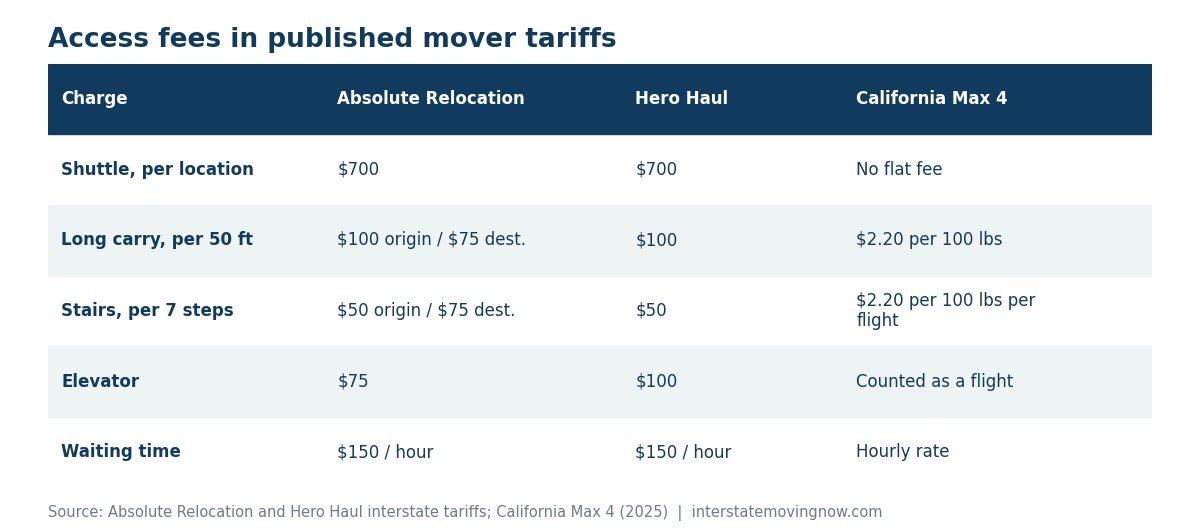
Rates vary by mover, so the real answer is in your mover’s tariff. To show the order of magnitude, we compared two interstate tariffs published online by FMCSA-registered movers, Absolute Relocation Service and Hero Haul, with California’s state-set Maximum Rate Tariff 4 (effective January 1, 2025), which caps what movers may charge for moves within California.
| Charge | Absolute Relocation (interstate) | Hero Haul (interstate) | California Max 4 (intrastate cap) |
|---|---|---|---|
| Shuttle, per location | $700 (or $1.50 per cu. ft., $350 min.) | $700 | Not a flat fee |
| Long carry | $100 per 50 ft at origin, $75 at destination | $100 per 50 ft | $2.20 per 100 lbs per extra 50 ft beyond 75 ft (distance-rated moves) |
| Stairs | $50 per 7 steps at origin, $75 at destination | $50 per 7 steps; first flight free at destination | $2.20 per 100 lbs per flight of 8 to 20 steps (distance-rated moves) |
| Elevator | $75 | $100 | Counted as a flight |
| Waiting time | $150 per hour | $150 per hour | Hourly rate |
Our analysis: on a 6,000-pound shipment, one shuttle at destination ($700), a 125-foot long carry (two 50-foot units, $150 to $200) and two flights of stairs ($50 to $150) add roughly $950 to $1,050 under these two interstate tariffs. On a $5,000 move, that is about 20% of the bill. Under California’s weight-based cap, the same long carry and two flights would be four units at $2.20 per 100 pounds, or $528, which shows how much the pricing method changes the result. These are examples, not national averages.
When do you have to pay a shuttle fee?
When the mover’s normal road equipment physically can’t reach your home and a smaller vehicle has to relay the goods. Tariffs usually treat this as an “impracticable operation.” Under 49 CFR 375.703, the mover can collect impracticable-operation charges at delivery only up to 15% of all other charges due; anything above that has to be invoiced later.
The fix is to find out before moving day. Check whether a 53-foot tractor-trailer can legally park on your street at both ends, whether your HOA or building bans large trucks, and how far the truck will be from the door. Tell the mover during the survey, and send photos of the street and entrance at the destination if it can’t be surveyed.
Can a mover add these fees after giving you an estimate?
Only within limits. 49 CFR 375.401(f) requires the mover to determine charges for accessorial services such as elevators and long carries before preparing the bill of lading. If the mover fails to ask and fails to price them, it must deliver your goods and bill you for those extras after 30 days, not hold your goods for them.
If a service becomes necessary after the bill of lading is issued, the mover must tell you what it is before doing it and give you at least one hour to decide, under 49 CFR 375.405. And a mover can only charge for services that appear in its tariff. As the Absolute Relocation tariff itself puts it, if a tariff does not designate charges for long carry or stairs, the mover cannot charge for them. Our guide to binding vs. non-binding estimates explains how each estimate type caps what you pay at delivery.
How can you avoid shuttle, long carry and stair charges?
- Describe both locations in detail during the survey: floor, stairs, elevator, distance from curb to door, truck parking.
- Reserve an elevator and a loading zone, and get any truck permits your city requires.
- Ask the mover to list every accessorial charge it expects on the estimate itself.
- Ask for the tariff page with its shuttle, long carry and flight rates. Movers must make the tariff available on request.
- Get a binding or binding not-to-exceed estimate that includes the expected access charges.
For a baseline before the extras, use our interstate moving cost calculator, and see how labor rates drive these fees in our moving labor costs report.
FAQ
What is a shuttle fee in moving?
A shuttle fee is the charge for using a smaller truck to carry your goods between your home and the mover’s large van when the van can’t reach the door. Published interstate tariffs we reviewed charge about $700 per location.
How far is a long carry?
Most tariffs include the first 75 feet from the truck to the door and charge for each extra 50 feet. California’s maximum rate tariff uses the same 75-foot threshold and 50-foot units.
Do movers charge for every flight of stairs?
Not always. Tariffs often charge per set of steps beyond a free allowance, and some exclude the first flight or stairs inside a single home. Check how your mover’s tariff defines a flight.
Can I refuse a shuttle on delivery day?
If the van truly can’t reach your home, the alternative is usually carrying farther or taking delivery somewhere else, which may cost more. Ask the mover to explain why the shuttle is needed and confirm the charge in writing before it starts.







No Comments